Build an itemized retaining wall budget from your material quantities and supplier or contractor prices. Compare the total, the material subtotal and the stated wall area without treating an example price as a quote for your location.
Maintained by BlockCalculatorPro. Check our reference cases.
How this calculator works
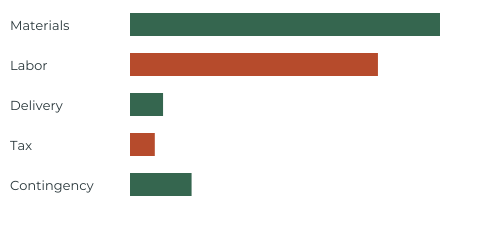
Material cost is the sum of each ordered item × its local rate in matching units. Add labor, equipment and delivery, selected tax, then contingency on the subtotal including tax.
Use quantities from a specified wall system. Local labor, access, drainage, engineering and permit costs must be included in the scope where applicable.
Price purchasing quantities for the chosen wall system
Start with the retaining wall material estimate. Carry over the selected wall system, block and cap counts, aggregate volumes and exposed area. Use the purchasing count after the chosen allowance when a supplier charges for whole units.
A concrete retaining wall cost can refer to segmental concrete blocks, mortared CMU or poured concrete. This budget follows the entered block wall system. A poured wall needs formwork, concrete placement and reinforcement quantities from a different takeoff.
For CMU, include the specified mortar, grout and reinforcement in the supplier quote or project extras. For a segmental system, confirm the core aggregate, base, drainage, caps and any reinforcement schedule. A low block unit price alone does not describe the complete wall material cost.
A transfer uses only the pipe length entered in the retaining wall tool. The wall run is not substituted for an unspecified pipe length. Confirm the material schedule before pricing the order.
Build the estimate from matching units and prices
Material line cost = purchasing quantity × price per matching unit.
| Line | Quantity and price unit | Common mismatch |
|---|---|---|
| Wall blocks | Whole units × price each | Mixing a pallet price with a unit count |
| Caps | Whole cap pieces × price each | Assuming a cap covers the same run as a wall unit |
| Aggregate | Cubic yards or supplier weight × matching price | Using a price per ton against cubic yards |
| Labor | Entered total or stated rate basis | Using an installed rate that already includes materials |
| Delivery and equipment | Quoted charge | Omitting minimum loads, access charges or rentals |
Keep the quantity unit visible beside every price. If aggregate is sold by weight, convert using the supplier density before applying that price. Do not assume that one cubic yard weighs the same for every stone or moisture condition.
Estimate labor from the same scope the installer priced
For an entered labor rate per square foot, multiply it by the area basis stated in the quote. A rate using exposed area differs from one using the full block face including buried courses. The calculator total should preserve the selected basis.
Ask whether labor includes excavation, spoil removal, compaction, drainage installation, cutting, cap setting and cleanup. Access for machinery, working room, wall curves, changes in level and the existing ground conditions affect the actual quote.
Large precast concrete retaining blocks can also require different lifting equipment, freight and installation methods. Obtain the price for that exact product and placement scope rather than applying a small landscape block labor assumption.
If you are preparing a bid, use this as the material and entered cost schedule. Overhead, supervision, permits, survey work, design fees and profit need deliberate treatment in your own bid. A homeowner budget and a contractor selling price serve different purposes.
Keep tax, contingency and unit cost transparent
Tax is the selected taxable subtotal multiplied by the entered tax percentage. Read the displayed tax basis before accepting the result. Local treatment of labor, delivery and materials can differ, so match the estimate to your supplier invoice or quote.
Contingency is a separate reserve applied to the stated subtotal. It is not additional installed work, and it is not the same as the physical block allowance. A block allowance changes how many units you buy; contingency changes the money reserved for uncertainties.
Cost per exposed square foot = total budget ÷ exposed wall area. Label that denominator when comparing estimates. A taller buried portion can increase material cost without increasing the visible area.
Worked budget with stated example prices
The following prices are chosen only to demonstrate the arithmetic. They are not a survey of current prices or a recommended labor rate.
| Item | Example calculation | Amount |
|---|---|---|
| Purchased blocks | 89 × $4 | $356.00 |
| Caps | 14 × $6 | $84.00 |
| Aggregate | Entered quoted material charge | $140.00 |
| Material subtotal | $356 + $84 + $140 | $580.00 |
| Labor | Entered amount | $600.00 |
| Delivery | Entered amount | $80.00 |
In this example only the $580 material subtotal is taxable. At an entered 7%, tax is $40.60. Materials, labor, delivery and that tax total $1,300.60. A chosen 10% contingency on that subtotal is $130.06, giving a budget of $1,430.66.
Changing which items are taxable or which subtotal receives contingency changes the answer. Use the same settings when comparing two scenarios.
Compare retaining wall quotes using the same checklist
- Confirm the same wall length, exposed height, buried height and wall system.
- Compare exact product names, cap details, colors and specialty units.
- Check the specified base, drainage zone, core fill and reinforcement quantities.
- Ask which excavation, disposal, access and equipment costs are included.
- Keep taxes, delivery, allowances and contingency visible.
- Identify work outside the quote and the circumstances that can change its price.
A retaining wall estimate becomes useful when the scope is clear enough to compare. The material list and entered costs here support that conversation; site conditions and final construction details still determine the contractor quote.
Common questions
Does this show an average retaining wall price for my ZIP code?
No. Enter prices from your suppliers and installers. The calculator combines those prices with your quantities so that the budget stays tied to a known scope.
Can I estimate labor cost for a retaining wall?
Enter the quoted labor total or use the rate basis supported by the tool. Confirm whether the rate applies to exposed area or total block area, and whether excavation, drainage, equipment and materials are included.
Is this suitable for a cinder block retaining wall cost estimate?
Yes, as an itemized budget for a specified CMU retaining system. Include the required mortar, grout, reinforcement and footing costs as separate quoted items or project extras. The tool does not determine their structural quantities.
Why are waste allowance and contingency separate?
Waste or spare allowance changes the physical purchase quantity. Contingency reserves money for uncertainty. Keeping them separate prevents an unexplained extra percentage from hiding how many blocks you are buying.
Can I use the total as a contractor bid?
Use it as a cost schedule within your own bid process. Confirm site work, overhead, supervision, permits, design, profit and contractual scope before setting a selling price.
Sources and product references
Named product references support the examples. Confirm the currently supplied dimensions, yields and purchasing conditions before ordering.
- Allan Block Commercial Retaining Wall ManualThe manufacturer manual includes a material estimate worksheet, separate wall materials and buried block quantities. Use specified project geometry and local product dimensions. This reference supplies no example prices. Manufacturer reference for product dimensions, material quantities and separate wall components. Confirm the locally supplied system.
- CMHA guide to segmental retaining wallsSystem components relevant to checking that a supplier or installer scope is complete.