Use this block wall cost calculator to turn a material takeoff into an itemized budget for a concrete block, cinder block, cement block or CMU wall. Quantity and price are separate decisions: first establish what the wall requires, then enter the supplier and labor rates for that project. Example prices are arithmetic illustrations, not national market rates.
Maintained by BlockCalculatorPro. Check our reference cases.
How this calculator works
Total = materials + labor + equipment + delivery + tax on the selected scope + contingency on the subtotal including tax. Whole pallet pricing rounds pallet purchases up before computing cost.
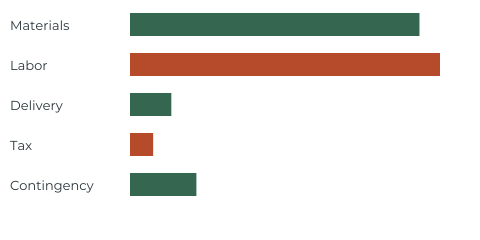
All preset prices are illustrative inputs, not current market rates. Replace them with local quotes and the scope you are pricing.
Set the scope before comparing a price
A bare unit price is only one part of a masonry wall budget. Two quotes can appear very different because one includes reinforcement, fill, foundations or finishing while the other includes only block laying.
| Budget line | What to enter |
|---|---|
| Blocks | Purchase quantity by unit type and current unit or pallet price |
| Laying mortar | Whole bags or documented site mix ingredients |
| Core grout | Specified fill quantity and supplier order price |
| Accessories | Quoted reinforcement, ties, caps, flashing and other specified items |
| Labor and services | Quoted installation, delivery, equipment and handling |
| Tax and contingency | Applicable tax treatment and a stated contingency basis |
Add other project items using actual quotes. A blank line means unpriced or excluded, rather than free.
When a wall project arrives without a calculated mortar quantity, choose whether to include supplied mortar bags or exclude mortar from this budget. An example bag count is not copied into the order. The result identifies the selected mortar scope.
Calculate materials, tax and contingency in a clear order
Block material cost = purchase units × price per unit. If you are buying complete pallets, use the number of pallets actually ordered and their quoted price. Include any separately purchased loose units without charging for the same blocks twice.
Add the quoted mortar, grout and accessory costs to obtain the material subtotal. Then add labor, delivery and other included services. Calculate tax on the portion that is taxable for your purchase. Confirm this with the supplier quote, because material, delivery and installation tax treatment can differ.
Final budget = included costs + applicable tax + contingency. State whether contingency applies before or after tax and which lines it covers. Retaining this basis makes revised quotes comparable and prevents a percentage from hiding missing scope.
Worked example with illustrative local quote inputs
Consider a 20 × 8 foot wall with 160 square feet of net masonry area and 180 installed nominal 8 × 16 face units. A chosen 5% block allowance produces a purchase quantity of 189 units. The following prices are invented for demonstrating the calculation.
| Line | Calculation | Amount |
|---|---|---|
| Blocks | 189 × $2.25 | $425.25 |
| Mortar | 15 bags × $9.00 | $135.00 |
| Material subtotal | Blocks plus mortar | $560.25 |
| Labor | Illustrative quote | $600.00 |
| Delivery | Illustrative quote | $80.00 |
| Tax | 8% of materials only in this example | $44.82 |
| Subtotal including tax | Included lines above | $1,285.07 |
| Contingency | 10% of the subtotal including tax | $128.51 |
| Total | Unrounded arithmetic, rounded for display | $1,413.58 |
This example excludes core grout, reinforcement, footings, equipment and finishes. Its total is about $8.83 per square foot of net masonry area for the listed scope only. Add the missing items when they are part of the project.
What does a 100 foot block wall cost?
Length alone is insufficient. A 100 foot wall that is 4 feet high has 400 square feet of gross face area. At 8 feet high, it has 800 square feet. Openings, unit selection, corners, structural requirements, access and finishing also affect the takeoff and labor.
For comparison, divide the complete included budget by a clearly defined area. Net masonry area excludes openings, while gross wall area does not. Use the same denominator for every quote. For a linear foot comparison, state the wall height alongside the result.
The homepage establishes block quantities from dimensions. This page prices the resulting purchase schedule. A retaining wall with base aggregate, drainage and backfill needs the separate retaining wall cost scope.
Foundation, fence, garage and building budgets
A block foundation estimate can include the masonry wall materials and a quoted installation allowance. It does not become a complete foundation budget until excavation, footings, reinforcement, waterproofing, drainage and other required work are priced.
For a block fence, identify piers, caps, finishes, footing work and access in the quote. For a garage or a whole building, the block wall budget is only one package. Slabs, roofs, openings, utilities, permits and interior work require their own quantities and prices.
Keep separate wall runs or unit types on a material schedule when their heights, products or finishes differ. One average unit price can obscure costly corner, specialty or decorative units.
Compare unit and pallet purchasing fairly
A lower price per block on a full pallet can still produce a larger order cost if many blocks remain unused. Compare the complete delivered total for loose units, full pallets plus loose units, and full pallets only where the supplier offers those choices.
- Confirm the exact number and product variants on each pallet.
- Ask whether delivery, unloading, fuel charges and pallet deposits are included.
- Identify refundable deposits separately from permanent material cost.
- Check returns, restocking conditions and whether loose specialty units are available.
- Use one currency and avoid adding tax twice to prices that already include it.
A contingency is a planning reserve. It should not replace an unpriced footing, reinforcement or delivery line.
Use the pallet and loose block comparison to see the full packs, loose remainder and excess units for the supplier count before pricing the order. Confirm that the displayed product reference and local price match the quotation you intend to compare.
Common questions
How much does a concrete block cost?
The relevant price is the current quote for your exact product, location and quantity. Hollow, solid, lightweight, decorative and specialty blocks can differ. Enter a supplier quote rather than treating an example price as a current nationwide rate.
Does this estimate include labor?
Include labor using your project quote or documented estimate, and check the result's included scope. A zero labor input does not establish an installed wall price. Access, height, cuts, reinforcement and finishing can change the work involved.
Should I price installed blocks or the order quantity?
Material purchasing should use the order quantity, including your chosen allowance. Labor quotes may be based on installed units, area or a fixed project amount. Keep their bases separate so spare blocks are not automatically charged as installed work.
Can this calculate the cost of a cinder block house or garage?
It can budget the specified block wall scope. A complete house or garage also needs other packages such as foundations, slab, roofing, doors, windows, utilities and finishes. Do not describe a wall material subtotal as the cost of a finished building.
What is the difference between cost per square foot and per linear foot?
Cost per square foot divides the budget by wall face area. Cost per linear foot divides by wall length and depends strongly on height. State the height, included items and whether openings were deducted whenever comparing rates.
Sources and product references
Named product references support the examples. Confirm the currently supplied dimensions, yields and purchasing conditions before ordering.
- CMHA: Estimating Concrete Masonry Materials, TEK 04 02ASupports the quantity basis, opening deductions and separate treatment of special units. All monetary amounts on this page are illustrative inputs, not prices from this source.
- QUIKRETE Mortar Mix No. 1102 product data sheetAn 80 lb bag lays up to 13 standard 8 × 8 × 16 inch units. Use coverage appropriate to the specified unit and bedding conditions. The product is premixed laying mortar, not core grout.